
The project explores how artificial intelligence can unsettle inherited ideas of dwelling and open space toward new forms of cohabitation. Starting from the observation that housing still reproduces rigid social, functional, and anthropocentric norms, the project uses AI as a method of defamiliarization: not to optimize existing typologies, but to loosen them.
The Aesthetics of Plurality: From Housing to Habitats
2022
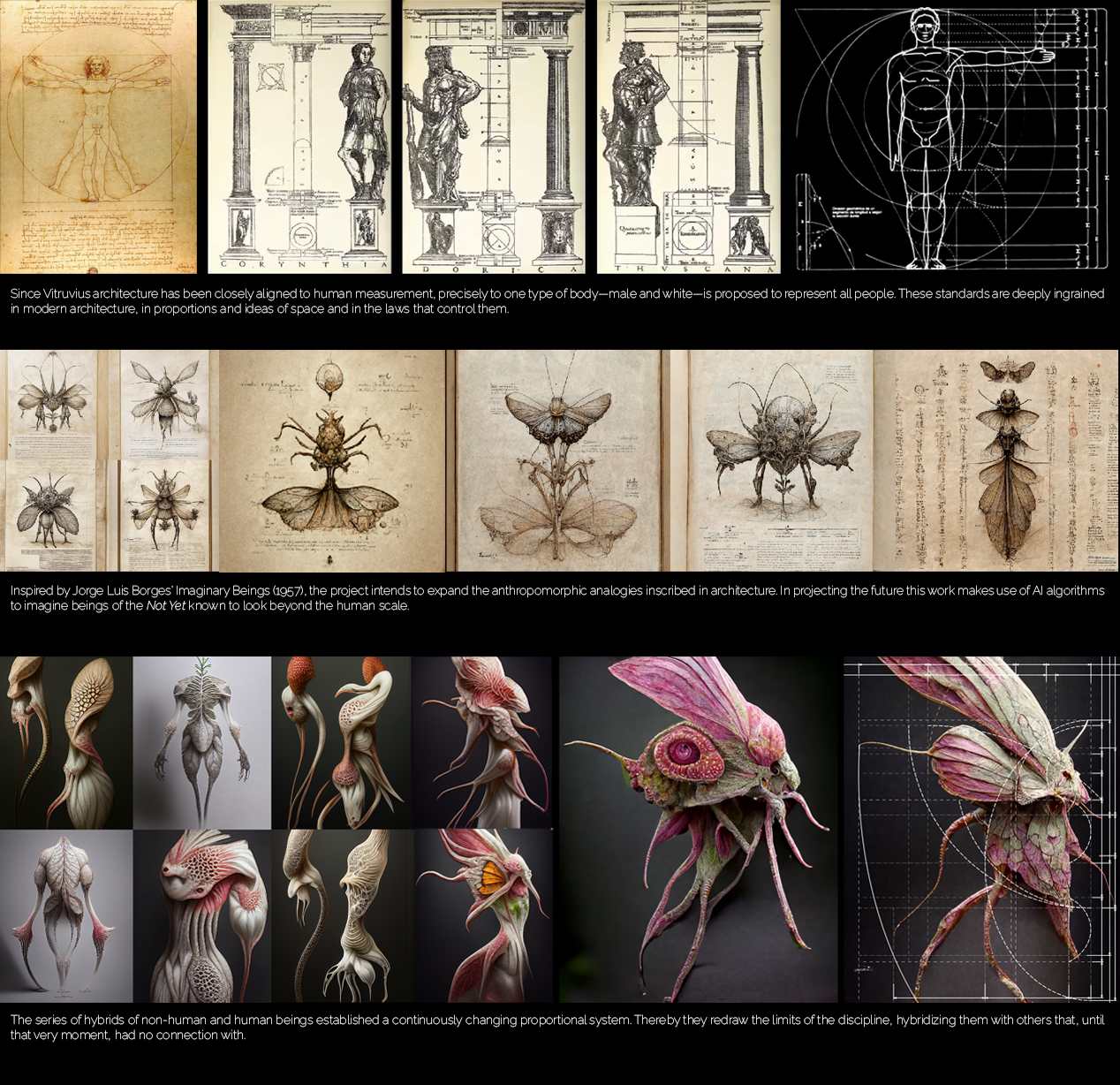
Reframing Architecture Through an Ecological Reference System
Since antiquity, architecture has repeatedly relied on the human body as a proportional model, most famously in the figure of the Vitruvian Man.
This project introduces another reference system: a synthetic hybrid being, generated through GenAI, that fuses human, animal, and plant characteristics. As a speculative figure, it unsettles the persistence of the universalized male body as architecture’s implicit norm and proposes a relational measure shaped by interdependence, transformation, and ecological entanglement. Architecture is understood here as part of a larger living system on which it fundamentally depends.
Method
Using an unsupervised generative AI workflow trained on curated three-dimensional architectural datasets, the project removes functional markers and semantic labels in order to interrupt typological certainty. The machine does not recognize kitchen, bedroom, or office; it operates on spatial relations, patterns, and formal organizations. This deliberate semantical loosening allows architecture to be reimagined as a field of evolving relations rather than a container of predetermined roles.
The project begins from the proposition that architecture has long materialized social and ecological exclusions. Housing, in particular, has been shaped by rigid distinctions between living and working, nature and culture, human and non-human. In response, the project proposes habitats instead of houses: spatial systems that are open-ended, relational, and capable of supporting plural forms of cohabitation.
The resulting spaces are neither conventionally domestic nor fully typologized. They emerge as hybrid spatial formations whose proportions, adjacencies, and hierarchies shift in relation to bodies, environments, and forms of living together. Rather than redesigning housing, the project reconsiders the very terms by which architecture takes measure. It proposes a spatial imagination in which human life is understood as part of, dependent on, and continuously shaped by a broader ecological world. AI becomes a catalyst for imagining how we might live differently—with one another and with the larger ecosystems that sustain us.
Credits
Part of the research project on 3D GANs supported by early-stage funding by the vice-rector of research, University of Innsbruck, Austria. grant no: W-182502
Publication
From Housing to Habitats: Artificial Intelligence as a Catalyst for a Radical Reinterpretation of Living Together in Zeitschrift für Literaturwissenschaft und Linguistik (LiLi) (2025)