
2020-2028
Chthonics
Chthonics is an ongoing series of artworks and research projects unfolding across different media, scales, and approaches. It brings together generative AI installations, robotic 3D printing, and research-based material investigations through a shared engagement with soil as matter, process, and more-than-human relation.
This series of projects explores soil as a living world of transformation, relation, and material intelligence. Working across generative AI, immersive installation, moving image, robotic fabrication, and research-driven experimentation, the project approaches the ground as a dynamic medium in which geological, biological, technological, and cultural processes continuously shape one another. Soil appears here as substrate, archive, metabolism, and agent: a fragile yet generative condition through which life is sustained, materials are formed, and environments emerge over time.
At the core of the series lies an interest in rendering perceptible what usually remains below the threshold of attention. Soil is often overlooked because its transformations unfold across scales and durations that exceed immediate human perception. Yet it is one of the most complex and consequential interfaces of planetary life: a zone in which mineral particles, organic matter, water, roots, microorganisms, climate, and human intervention enter into dense and ongoing relations. The projects engage this complexity as a field for artistic and architectural inquiry, asking how aesthetic, spatial, and computational practices might open new ways of sensing soil as a living process.
Generative AI, digital visualization, and robotic fabrication are brought into dialogue with earth-based matter, environmental processes, and site-responsive conditions, allowing the works to move between the digital and the material, the microscopic and the territorial, the sensed and the imagined. In this way, the series uses contemporary forms of seeing and making to deepen our relation to the living earth.
The projects are united by a concern with soil as a site of memory and becoming. Soil holds traces of climatic shifts, decomposition, growth, erosion, extraction, cultivation, and decay; it carries layered histories while remaining open to continuous transformation. To work with soil, or through its logics, is therefore also to engage questions of time, inheritance, fragility, and future formation. What emerges is a set of propositions through which it can be encountered as living infrastructure, more-than-human habitat, material intelligence, and a condition of habitation that precedes and exceeds the built.
2024
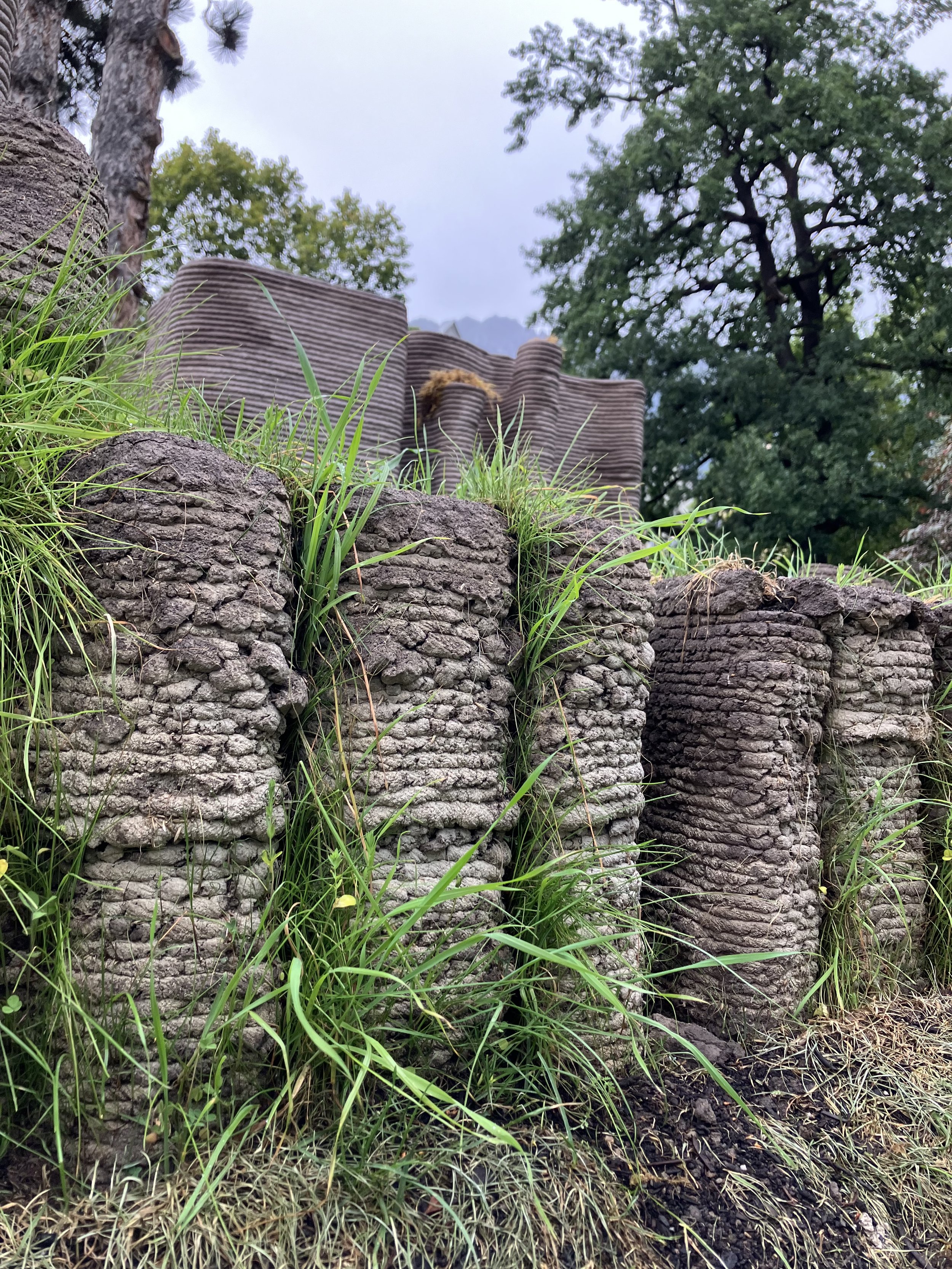
Xeno-tékton
Xeno-Tékton is a speculative art project that explores climate change through an expanded understanding of solidarity, one that includes human, non-human, and technological forms of agency. Drawing on Donna Haraway’s and Karen Barad’s thinking, the work approaches art-making as a multispectral process of co-creation in which species, machines, artificial intelligence, and robotic 3D printing participate as interconnected actors rather than separate domains.
Through sculptures equipped with sensors that record electrophysiological and environmental data, later analyzed by AI to detect patterns beyond human perception, the project investigates how communication and transformation emerge across species, ecosystems, and technologies. xeno-tékton proposes a vision of more symbiotic and just ways of living together, opening a space to imagine how communities might be reconfigured in response to planetary change.
in collaboration with Benjamin Ennemoser
collaborating scientists: Thomas Pümpel, Arwyn Jones, Calogero Schillaci
fabrication support: REXlab, University of Innsbruck, Austria
Commissioned by KÖR Tirol and funded by the Land Tirol.
Exhibited: Waltherpark, Innsbruck, Austria
2024
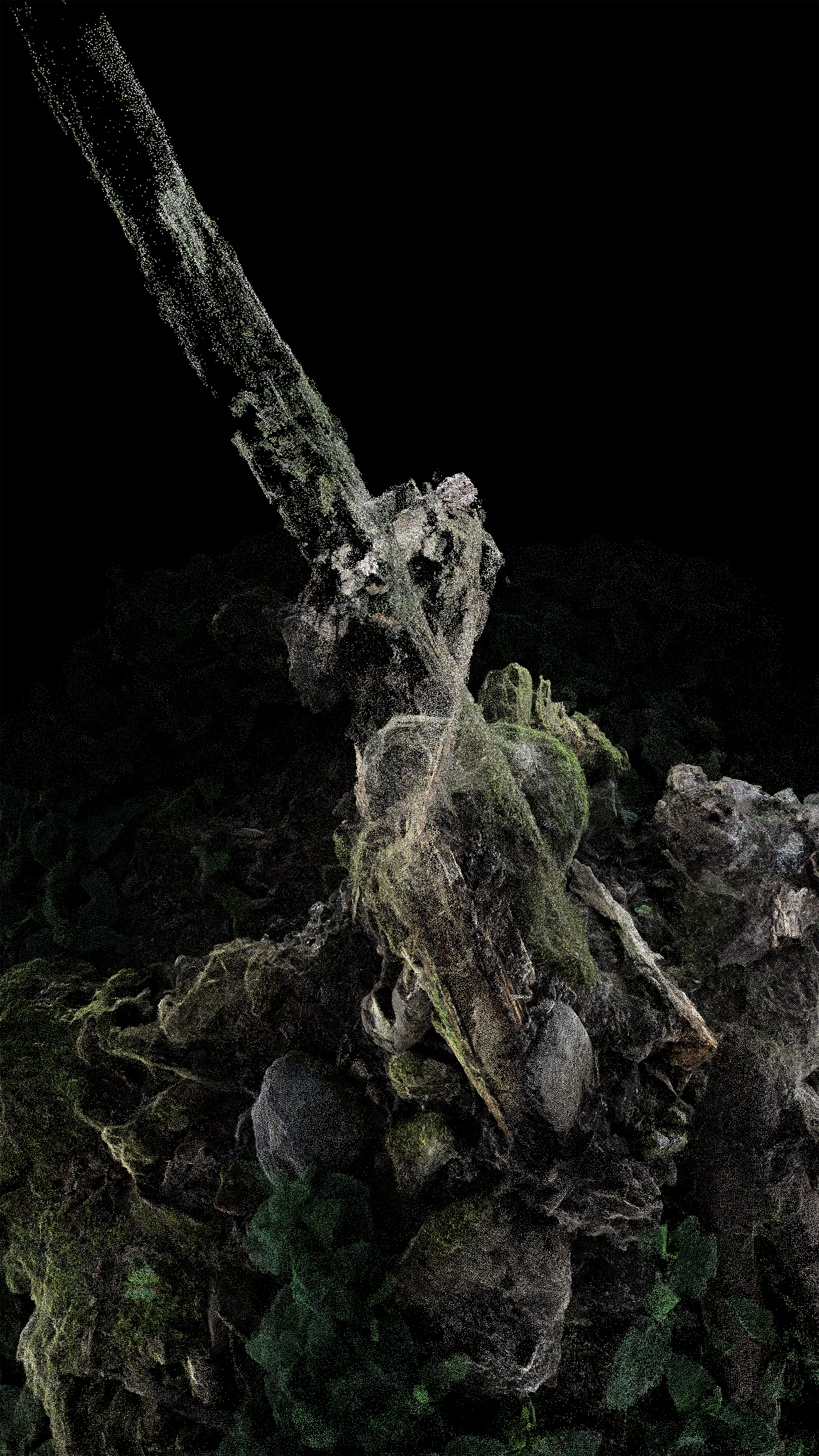
Compos[t]ing
Compos[t]ing approaches pedogenesis as a form of material composition in which soil emerges through the slow tectonics of accumulation, erosion, compression, and transformation. Developed as a generative digital soil sculpture, the work combines image-based field research, soil data, and computational processes to investigate how heterogeneous particles, organic matter, and temporal layers are continuously composed into unstable material formations.
The project treats soil not as inert ground, but as an active, relational substrate whose structure is shaped by intertwined geological and biological processes across deep time. By translating these processes into a speculative digital environment, Compos[t]ing reflects on soil as a material intelligence and as a formative condition for architecture, ecology, and habitation.
collaborating artist: Ingrid E. M. Ogenstedt;
collaborating scientists:: Calogero Schillaci, Arwyn Jones, Jonah Lynch
Commissioned by the European Commission’s Joint Research Centre (JRC) as part of the SciArt Resonances IV program.
Exhibited: NaturArchy iMal - Art Center for Digital Cultures & Technology – Koolmijnenkaai, Belgium
Publication: NaturArchy: a multidisciplinary exploration of soil science & art in Discover Soil, 2026
Compos[t]ing in NaturArchy: Towards a Natural Contract, Vol. 1, Quodlibet, 2026

2025
Invisible Universe
Invisible Universe: Our Entanglement with Soil is an immersive site-specific audiovisual installation that explores soil as a living spatial and material condition. Conceived for a large-scale public setting, the work transforms scientific knowledge of soil ecosystems and soil DNA barcodes into a dynamic visual and sonic environment in which subterranean processes become perceptible as active formations of matter, time, and interdependence.
Through AI-generated imagery, animation, and interactive technologies, soil is approached not as inert ground, but as a complex and unstable substrate shaped by the entanglement of mineral particles, organic life, microorganisms, and environmental forces. The installation brings these otherwise inaccessible dynamics into an immersive perceptual field, opening a space in which the hidden architectures of the subsurface can be encountered aesthetically as well as conceptually. In this way, the work invites reflection on soil as a fragile yet generative medium that underpins ecology, habitation, and planetary life.
developed for the Biosfera Prize, The Nature of Culture, Fondazione Pescheria – Centro Arti Visive, Pesaro, Italy
medium: Immersive site-specific audiovisual installation; 360° spherical video work with integrated 4-channel spatialized sound
dimensions: 2240 × 1084 px, Codec: ProRes 422, H. 265
duration: 3:12 minutes